

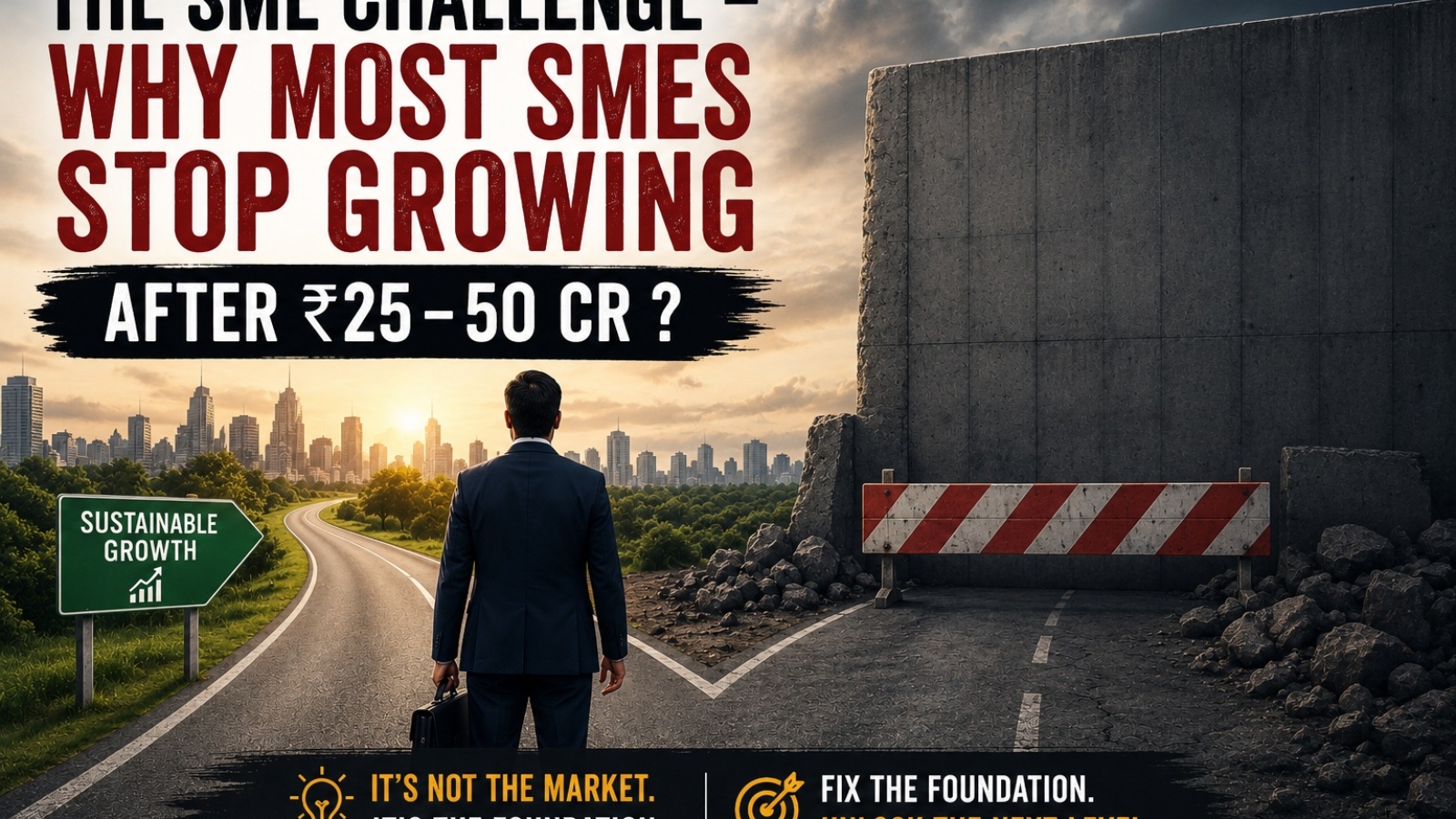
After working with hundreds of SME founders across manufacturing, retail, distribution, healthcare, real estate and service etc, I realized something important:
Most SMEs don’t fail. They plateau. Typically somewhere between ₹25–50 Cr
At that stage:
sales can still happen
customers still exist
business looks stable
But internally:
chaos increases
profitability fluctuates
teams become dependent
founders become exhausted
And growth suddenly slows down. In most cases, the issue is NOT market demand.
The issue is: the current structure helped them reach ₹25 cr but it cannot take then to ₹100 Cr or ₹300 Cr
I believe these are the biggest reasons why :
1. The Founder Becomes The Biggest Bottleneck
In many SMEs, the founder is still the sales manager / head, recruiter, approver, production manager & so forth. The founder still is busy in
approving quotations
solving escalations
reviewing collections
managing key sales
taking hiring decisions
monitoring operations
Initially, this hustle helped to reach where you are but after this point, it kills scalability. One manufacturing business we worked with had stagnated around ₹30 Cr for almost 3 years. You know what was the interesting part ? Every important decision still went through the founder.
Sales teams waited for approvals /pricing Operations slowed down Managers were hardly taking any ownership
Then what helped ? — >
Clear delegeation structures
Establishment of KPI ownerships
Reporting systems
Second-line leadership (this is where a lot of entrepreneurs try to save money, DON’T)
The business scaled to ₹60+ Cr over time. Not because the founder worked harder.
Because the business had stopped depending entirely on him. He was rather happier, more relaxed and still growing faster.
2. Why is a strong middle management important for success ?
Most SMEs upto ₹25cr revenue have:
junior execution teams OR
founder-led control
What’s missing?
Strong middle management
Lack of this creates:
daily firefighting
no accountability
poor execution consistency
founder overload
One retail business had multiple stores but every operational issue still reached the promoter. Store managers were managing stores… but not owning business outcomes. Post restructuring exercise, they had clear
review systems
store KPIs
incentive structures
regional accountability
…store productivity improved significantly within months.
The founder finally got time to focus on growth instead of firefighting.
3. Are you still running your business on Whatsapp & Excel Sheets ? – You will lack behind.
This is more common than people think.
₹30–50 Cr businesses still operating through:
WhatsApp
Excel sheets
Verbal approvals
Fragmented reporting
One client proudly told us: “Sab mere dimaag mein hai.”
That’s not scale. Dimaag mein kitna rahega ?? As businesses grow: systems become more important than effort.
The companies that scale beyond ₹100 Cr usually become: process-driven before they become enterprise-driven.
4. Poor MIS = Poor Decisions
Many founders don’t know their
Monthly P&L
Actual Outstanding & its ageing
Sales Productivity & Funnels
Customer-level margins
Inventory Ageing
Shop floor productivity %
Working capital efficiency & many more
These are very important along with other metrics. Instead, what do they track ?
bank balance
topline sales
monthly expenses
And what doesn’t get measured, doesn’t improve
One healthcare business believed marketing costs were hurting profitability. But deeper analysis showed:
inefficient pricing
low-margin customers
funnel leakages
poor sales visibility
Once proper MIS dashboards is implemented: profitability improves faster than revenue growth.
This changed the business.
5. Sales Chaos Eventually Breaks Growth
This is one of the biggest hidden problems in SMEs. Sales teams operate differently.
No CRM discipline. No funnel visibility. No forecasting. No structured follow-ups.
Everything depends on:
founder relationships
few star salespeople
market momentum
That works till a point. Then growth becomes unpredictable.
One business improved dramatically after implementing:
sales funnel tracking
CRM workflows
conversion visibility
channel partner analytics
The result? Sales efficiency improved massively without proportionately increasing marketing spends.
The Hard Truth
Most SMEs don’t stop growing because of competition.
They stop growing because:
A founder is scaling revenue and working mostly like a multi-headed SuperHuman but not scaling the organization.
There is no pride in this. You are underestimating yourself if you are doing so.
THERE IS A BIG DIFFERENCE
What Changes Between ₹25 Cr And ₹250 Cr?
₹25 Cr Business
Founder-driven
Informal execution
Relationship-led sales
Whatsapp or Excel reporting
Firefighting
₹250 Cr Business
System-driven
Structured accountability
Process-led sales
MIS dashboards
Strategic planning
My Final Take
I sincerely request SME Owners to:
build systems early + leverage technology & AI
strengthen middle management
adopt data-driven decision making
professionalize execution
reduce founder dependency
The founder’s hustle can build a business. But scalable systems build institutions. This is where you want to be..
Over the last year, we’ve been working closely with mid-market businesses across manufacturing, retail, real estate, healthcare and services helping them identify:
operational leakages
growth bottlenecks
profitability gaps
scalability challenges
AI & automation opportunities
Add a Comment